


Embracing Growth Through Adversity: Lessons from the Marsh

Finding Beauty in the Struggle
At the end of my yard at "The Sanctuary"—our home nestled on the marsh—wild blackberries and marsh morning glories grow. It’s one of the simple joys of late spring and early summer. As I take my dogs, Tank and Lulu, out in the yard, we make our way to the marsh, and I joyfully get to pick these sweet little blackberries. Each time, I only get a small handful—relishing that I got to them before the birds! As I munched on my sweet yet slightly bitter treat, I thought: these berries are like us somehow.

They grow in brackish water. Not quite salt. Not quite fresh.
The ground is soggy, often unstable, and frequently overlooked. And yet, here they are—vining their way through the marsh grass, climbing over themselves, stubborn and beautiful. They bear fruit in places most would never plant.
Navigating Life's In-Between Spaces
Isn’t that how life is? Many of us are trying to grow in in-between places. Places that aren't clear-cut. We’re navigating seasons where stability feels far away, where we’re not rooted in certainty. The ground beneath us shifts—sometimes daily. And yet, we bloom. We adapt. We reach toward the sun even when there are clouds.
What’s remarkable is that psychological research supports this picture. Studies have shown that suffering and hardship—though painful—can cultivate qualities we would never develop in easier circumstances. This phenomenon is often referred to as post-traumatic growth (PTG). Researchers Tedeschi and Calhoun (1996) define PTG as the positive psychological change experienced as a result of struggling with highly challenging life circumstances. It’s not about denying the pain but discovering unexpected fruit that comes from it: greater appreciation for life, deeper relationships, increased inner strength, spiritual growth, and a redefined sense of purpose.
The Flavor of Resilience
And like the blackberries growing along the marsh, that kind of growth carries a distinct flavor. They carry a sweetness in them, but it’s not the sugary kind. It’s the kind that has a trace of something deeper—a bit of bitterness, shaped by the very conditions in which they grow.
That slight bitterness in the berry isn’t a flaw. It’s a mark of its resilience. Wild blackberries develop higher levels of polyphenols—like anthocyanins and tannins—especially when grown in stressful conditions. Those are the very compounds that give the berry its deep color and powerful antioxidant properties. In other words, the bitterness is the result of what makes it strong.
In much the same way, people carry this too. When we’ve gone through suffering, there can be a trace of bitterness—not the kind that makes a person hard or cynical, but the kind found in fruit that has weathered a storm. It’s an edge that tells the truth. It grew in hard places. It was shaped by adversity, not ruined by it.
The Science of Resilience
In the same way, hardship can leave a mark on us—but it’s often that very mark that makes us more resilient, wiser, and more present. Neuroscience confirms this too. While chronic stress can be damaging, studies also show that moderate levels of adversity can actually strengthen coping skills, enhance emotional regulation, and deepen empathy (Seery et al., 2010). Like the blackberry, we become more potent through what we’ve survived.
Scripture speaks to this paradox—that suffering can produce something good in us. Romans 5:3–4 says, “We also glory in our sufferings, because we know that suffering produces perseverance; perseverance, character; and character, hope.” It’s not that we chase pain, but that we begin to see the fruit that grows from it when we walk through it with God. Even in what feels bitter, there can be a seed of grace.
The Importance of Connection
But there’s another side to this.
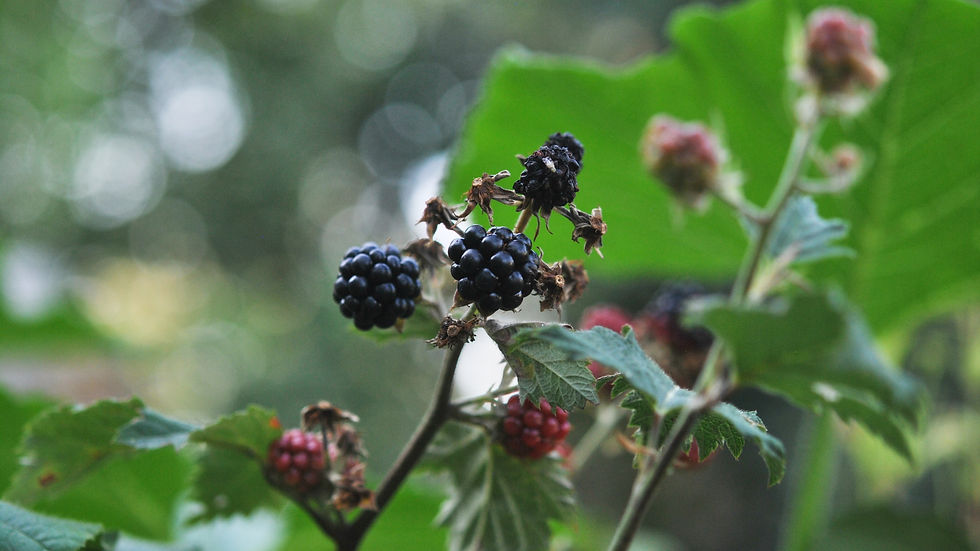
That kind of strength doesn’t grow in isolation. Blackberries grow in tangled clusters, connected by vines. They support one another as they reach for sunlight. Likewise, healing and growth after hardship are most sustainable when we’re rooted in safe, supportive relationships. In fact, one of the most predictive factors for resilience isn’t just grit—it’s connection. According to research published in Psychological Science, people who reported close, trusting relationships were more likely to bounce back from adversity with perspective and even joy.
And maybe that’s part of the sweetness too—when we realize we’re not doing this alone.
Finding Purpose in Pain
And so maybe there is purpose in our struggle. Not because pain is good—but because even in pain, something good can grow. Beauty doesn’t just bloom after the hard places—it often blooms in them. Not all at once. But steadily, if we pay attention.
Peace doesn’t require the absence of grief. It doesn’t mean pretending things are fine. Sometimes it just means noticing: I’m still breathing. The breeze is still blowing. There is beauty here, even now.

Scripture echoes this too: “Though outwardly we are wasting away, yet inwardly we are being renewed day by day. For our light and momentary troubles are achieving for us an eternal glory that far outweighs them all” (2 Corinthians 4:16–17).
Conclusion: Grace in the Marsh
This is grace in the marsh. Still growing. Still sweet. This is what grace looks like sometimes. It’s wild. Tangled. Slightly bitter. But it’s beautiful. And somehow—it still grows.
References:
Tedeschi, R. G., & Calhoun, L. G. (1996). The posttraumatic growth inventory: Measuring the positive legacy of trauma. Journal of Traumatic Stress, 9(3), 455–471.
Seery, M. D., Holman, E. A., & Silver, R. C. (2010). Whatever does not kill us: Cumulative lifetime adversity, vulnerability, and resilience. Journal of Personality and Social Psychology, 99(6), 1025–1041.


Comments